

 Inflation Reduction Act of 2022 (HR 5376) – This legislation was originally introduced as the Build Back Better Act, President Biden’s signature bill of 2021. After suffering defeat in the Senate, the bill was later revised with fewer provisions to enhance its likelihood of passage, and renamed the Inflation Reduction Act. The bill authorizes funding for investments in domestic energy production and manufacturing with the goal of reducing U.S. carbon emissions by 40 percent by 2030. The bill provides tax credits for clean energy home enhancements and electric vehicle purchases, permits Medicare to negotiate prescription drug prices,and extendslower healthcare premiums for insurance purchased via the Affordable Care Act program through 2025. Also billed as a deficit reduction tool, the legislation imposes a minimum 15 percent corporate tax rate on large businesses with more than $1 billion in reported income, and a 1 percent excise tax on corporate stock buybacks. Furthermore, the bill increases previously reduced funding for the IRS in order to help track down and recoup taxes unlawfully skirted by high income earners. Initially introduced on Sept. 27, 2021, the Act was passed by both the House and the Senate in August and signed into law on Aug. 16.
CHIPS and Science Act of 2022(HR 4346) – This legislation includes $280 billion in funding to build a domestic supply chain for semiconductor chips as well as scientific and technological research to help keep U.S. industries competitive. The bill authorizes new and expanded investments in STEM education for K-12 to community college, undergraduate and graduate education.The bill was enacted on Aug. 9.
Bipartisan Safer Communities Act (S 2938) – Introduced by Sen. Marco Rubio (R-FL) on Oct. 5, 2021, this Act expands background checks for anyone under age 21 who seeks to purchase firearms, and offers incentives for states to pass red flag laws to remove weapons from people deemed a threat to themselves or others. The bill provides $11 billion in funding for mental health services in schools and local clinics, and to support mental health courts, drug courts, veterans’ courts and extreme risk protection orders. The final version of the bill passed in the Senate on June 23 and in the House on June 24. President Biden signed the bill into law on June 25.
Honoring our PACT Act of 2022 (S 3373) – This legislation, which expands healthcare benefits for veterans who were exposed to burn pits and other toxic substances while on active duty, was introduced by Sen. Tim Kaine (D-VA) on Dec. 9, 2021. Amid much fanfare and controversy this summer, this bipartisan bill was finally passed in both the House (July) and the Senate (August, requiring a second vote) and was signed into law by President Biden on Aug. 10.
PPP and Bank Fraud Enforcement Harmonization Act of 2022 (HR 7352) – Introduced by Rep. Nydia Velazquez (D-NY) on March 31, this bill amends the Small Business Act to extend the statute of limitation to 10 years for criminal charges and civil enforcement against borrowers under the Paycheck Protection Program, enacted during the early stages of the COVID-19 pandemic. The bill passed in the House on June 8 and in the Senate on June 28. It was enacted on Aug. 5.

 Despite borrowing massive amounts of money, the government still needs to find ways to raise revenue to pay for new programs and spending. The current democratically controlled Congress is looking to potentially implement new social programs and a climate bill. As a way of funding these initiatives, they are considering an expansion of the Net Investment Income Tax (NIIT).
 Whether it’s tariffs, trade wars or post-pandemic inflation caused by kink-ridden supply chains and what many experts believe to be excess money printing, inflation is an insidious drag on businesses’ operations. When it comes to energy’s contribution to inflation, the U.S. Energy Information Administration (EIA) reports that crude and natural gas prices in 2022 have increased on an annualized and weekly basis. Looking at the snapshot of 7/21/2022, WTI crude on the futures market was $96.35 a barrel. This was up more than $26 compared to 12 months ago, and $0.57 higher than a week earlier. For the same time frame, natural gas futures were $7.932/MMBtu, an increase of $3.973 from 12 months ago and an increase of $1.332 from a week earlier.
 Imagine selling slices of a large pizza. You can cut it into four even slices and charge $2 a slice. Or, you can cut it into eight even slices and charge $1 per slice. Either way, the total value of the pizza will still be $8.
 Even though summer is still somewhat in full swing, school will be starting soon. Yes, you heard that right. This means that you probably need to get prepared for the inevitable cash outlay ahead. But it doesn’t have to cost an arm and a leg. Here are some ways to navigate the upcoming expenditures and save a penny or two.
 Non-fungible tokens (NFTs) are rising in demand, and some brands are already generating great results in their campaigns and providing a unique experience to customers. As the hype around NFTs continues, businesses need to understand how they can benefit.
 Supply Chain Security Training Act of 2021 (S 2201) – This legislation is designed to identify supply chain risks and develop a government program to train federal officials with supply chain risk management responsibilities to prepare and mitigate those risks. The training program would cover the complete acquisition life cycle, including funding for data access and processing as well as appropriate technology and communication vehicles. The bill was introduced by Sen. Gary Peters (D-MI) on June 23, 2021. It passed in the Senate on Jan. 11 and in the House on May 10. It was signed into law by the president on June 16.
 One of the perennial fears of taxpayers is getting audited by the IRS. Financially, few scenarios strike such fear into the heart of taxpayers. However, taxpayers can probably breathe a sigh of relief – at least for now. This is because the rate at which the IRS is initiating audits of individual taxpayers is dropping like a stone.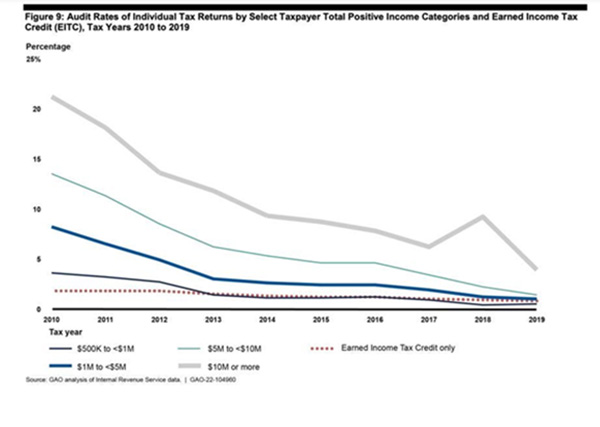

 Corporate profits, according to the Bureau of Economic Analysis, grew by $20.4 billion in the final quarter of 2021, a 0.7 percent increase. For the first quarter of 2022, corporate profits fell by 2.3 percent or $66.4 billion. On an annualized basis, corporate profits fell 5.2 percent in 2022, but grew 25 percent in 2021. With the economy facing inflation, the uncertainty of the Russia/Ukraine conflict, and the world working its way out of the COVID-19 pandemic, economic uncertainty abounds. For companies, measuring margins is one way to evaluate performance and strategize ways to survive and thrive in a dynamic economy. Here are a few common margins that businesses can determine to measure their financial performance.
 Starting June 1, the Fed began reducing its balance sheet holdings of U.S. Treasuries by $30 billion a month for three months. Thereafter, it will double its reduction of U.S. Treasuries by $60 billion per month beginning in the fourth month. For its mortgage-backed securities, the first three months will see $17.5 billion roll off its balance sheet. Starting in the fourth month of the program, this cap will increase to $35 billion per month. As its dual mandate is to both maintain employment and a stable rate of inflation, this is another way the Fed is implementing its monetary policy to put the brakes on inflation and reign in out-of-control demand with limited supply. How will the Fed’s unwinding of its balance sheet impact markets for the rest of 2022?