
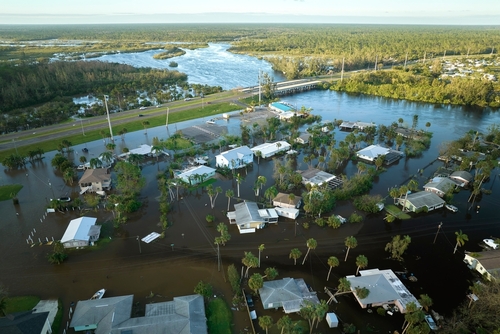
 The recent hurricane Ian impacted much of the southeast United States. As a result, it is good to know the general tax rules related to disaster victims. Below, we look at several tax topics for disaster area victims.
1. Tax Returns and Filings
Q: I am a disaster area victim and needed to move from my home. I might not be back for a long time or even at all. Which address should I use on my tax return?
A: A taxpayer should always use their current address in filing a tax return. In the situation where you move after filing your return, you need to update your address with the IRS. You can do this either by filing form 8822 or calling the IRS Disaster Hotline at 866-562-5227.
Q: I filed an extension for my form 1040, giving me until Oct. 15 to file. Are there any further extensions available?
A: Taxpayers who already filed for an extension until Oct. 15 and live in a federally declared disaster area of the recent hurricanes receive an automatic extension due date of Dec. 31.
2. Payments
Q: I have a balance due on my 2021 tax return and am currently accruing interest on it. Is there any relief for disaster victims on interest charges?
A: No, the IRS is not giving any forbearance or cancellation of interest on tax balance liabilities. The IRS is, however, willing to waive late payment penalties when the taxpayer can prove the reason they are late is caused by issues related to the disaster.
3. Property and Casualty Loss
Q: During a recent disaster we lost electricity and all the food in my refrigerator and freezers spoiled and I had to throw it away. My homeowners’ insurance reimbursed me, and it was for more than the food cost me. Do I have to report any income on the amount over my food costs?
A: No. The tax code makes a distinction between scheduled property and general reimbursements. For unscheduled property (general reimbursements), the taxpayer does not need to recognize income for reimbursements on personal property, even if it was more than the cost of the lost property.
Q: I need to prove the reasonable value (FMV) of my home. Am I allowed to use property tax assessments to substantiate the FMV of my home?
A: No, the only way a taxpayer can establish the FMV of a property is either with an appraisal by a credentialed appraiser or using the cost of repairs method.
4. Sale of Home
Q: My primary residence was destroyed and the cause was deemed to be a federally declared disaster. After clearing the lot, I sold the land alone for a gain. Do I have to pay taxes on the gain or is there an exclusion since it is where my primary residence used to be?
A: Selling a vacant lot does not qualify for the exemption on gains from primary residences. The exception to this rule is if the land previously had the taxpayer’s main residence on it. In this case, if the taxpayer would have qualified for the main residence exemption before the disaster, the gain on the sale of the vacant land would be exempt here as well.
5. Expenses
Q: I worked in a federally declared disaster area and had to move for my job at my own expense. Can I deduct my travel and related expenses?
A: The answer depends on whether or not the move is expected to last for more than one year. If you expect the move to be temporary, defined as less than one year, then there is no change in your tax home. In this case, you can deduct travel and related expenses to get you both to and back from your temporary work assignment. If the move is long-term, defined as more than one year, then the expenses are not deductible, regardless of whether your employer reimbursed you.
 The Importance of Auditing
 Are you a trader or an investor? The difference is frequently discerned by how closely you monitor the stock market and how quickly you move in and out of investments. Traders are often referred to as market timers because they actively seek to buy into positions when share prices drop, and sell out when those prices rise.
 There’s no better time than the holidays to show your employees and your clients how much you appreciate them. Here are five simple steps to help you craft the perfect email in no time.
 Early technology adopters are more likely to gain better business results, including higher revenue growth and market position. With businesses facing complex problems every day, it is no doubt that they are always watching out for the next big tech that offers a better solution.
 Planning for Animal Wellness Act /PAW Act (S 4205) – Introduced by Sen. Gary Peters (D-MI) on May 12, this act instructs the Federal Emergency Management Agency (FEMA) to compile best practices and federal guidance for handling household pets, service and assistance animals and captive animals during emergencies and disasters. Initiatives include preparedness (e.g., sheltering and evacuation planning), response and recovery.The bill passed in the Senate on Aug. 6, in the House on Sept. 14 and was signed into law on Oct. 17 by President Biden.