
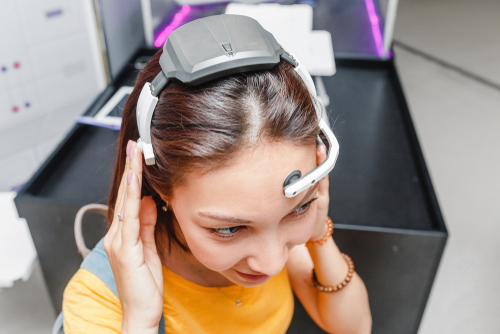
 Imagine using your mind to control machines, or your employer reading how you feel in real time from a dashboard? This is the future of BCI technology.
Do we really need this technology? What are the potential benefits and possible implications of this emerging field?
What is BCI?
Brain Computer Interface (BCI) is also referred to as Brain Machine Interface or Neural Interface.
Wikipedia defines BCI as a direct communication pathway between an enhanced or wired brain and an external device.
The brain is said to process billions of bits of information per second and runs on electrical signals that could control electronics, and BCI attempts to create this connection.
The BCI technology that connects internally (invasive BCI) or externally (non-invasive BCI) to the brain is meant to read brain activity and process it to information and even transmit information back to the brain.
Although this research began in the 1970s, the first neuroprosthetic device to be implanted in humans was done in the mid-1990s. Currently, large tech firms and a good number of startups are already working on producing cheaper, safer and more accurate BCIs.
The hype around BCI has been pushed by advanced modern computing, data science, machine learning and neural networks. A combination of the brain and artificial intelligence would surpass human capability.
Applications of BCI
BCI is already used in medicine to measure brain signals for medical applications such as cochlear implants, which are used by individuals with hearing deficits. These implants translate audio signals to electric pulses that are sent directly to the brain.
Other uses in medicine include detection and diagnosis, such as forecasting and detecting abnormal brain structure and other brain disorders such as epilepsy.
According to researchers, BCI could even replace lost functions, such as speaking or moving and general control of the body. This is beneficial to people with different forms of longstanding paralysis, such as that caused by a stroke.
BCI would also help improve quality of life for elderly patients, especially due to changes in memory and brain function as a result of aging. Assistive BCI would help those suffering from motor control impairments to control home appliances in a smart home.
BCI in Business
Although initially meant to help in medical issues, other applications of BCI are emerging. Several companies and startups are exploring application of BCI not related to medicine. These fields include:
- Marketing – to help measure attention levels of commercial and political ads, with an intention to optimize the ads. Companies will benefit from brain data as it will help increase product or service personalization.
- Workplace analysis – to help improve performance at work. This is possible using headbands that measure mental fatigue, the cognitive state, stress levels and focus levels. As a result, the work environment would adapt to employee stress levels and thoughts. For drivers operating dangerous machines, BCI will help analyze signals of drowsiness and give an alert or stop the machine to avoid accidents. Employers could use BCI when evaluating, monitoring and even training employees.
- Education – to help teachers personalize their interaction with students depending on the students’ ability to grasp concepts.
- Entertainment – BCI offers an immersive experience with the ability to control avatars in video games using thoughts. It would be possible to produce games that respond to the mood of players and their attention level, thus creating a personalized experience.
- Military – to help in controlling or piloting a swarm of drones.
BCI Challenges
It is reasonable to have technology that improves the quality of lives for people who have disabilities. But when it comes to augmenting functions of a physically fit human, this technology raises ethical concerns and debates.
First, who will own the data produced by our brains? We already have cases of personal data generated on the internet that is being sold. How safe would the data be that is generated by BCI; especially considering that BCI is invasive and involves sensitive personal information such as feelings, moods and emotions.
The thought that a third party can access your personal data without your knowledge brings up questions of privacy. Another person would know exactly how you feel at a given time; and if companies were to roll out the use of BCI, what rights would employees have?
What would happen if the BCI device is hacked? Brain data could be intercepted by hackers who would then know more about you than you’d want to share.
Human augmenting will also give unfair advantage over those who cannot afford BCIs; and at some point the efforts to transcend human limitations could be a disaster.
More potential risks include people being controlled, misuse by rulers, psychological harm, unknown long-term mental effects, and physical harm such as brain damage or hemorrhaging in cases of invasive BCI.
The Future of BCI
The BCI technology offers many benefits. But before actual BCI systems reach the market for consumer application, the risks and unknowns can’t be ignored. This begs for a plan on ethical and policy issues. Business leaders also should start considering a BCI strategy as well as new BCI business models to balance the potential benefits and address the risks.

 Digital marketing is not a new phenomenon. However, new realities imposed by the COVID-19 pandemic have highlighted the importance of digital marketing for businesses. Basically, digital marketing revolves around using digital channels to advertise. Such channels include mobile devices, search engines, social media, websites, email, and others to help reach consumers. The purpose is to create a relationship with potential online customers to influence their buying decisions.
 Away from the movies, robots are becoming a reality in everyday life.
 With increased cyber threats, there is great awareness of malware that comes attached in files. Individuals and businesses invest in security solutions to protect against malware. In fact, there are often company policies regarding opening attachments on emails; yet there is an increase in a type of threat (though not new), known as the fileless malware.
 Most states are starting to relax stay-at-home restrictions. As such, businesses are developing plans for bringing employees back to work. Many businesses are already affected by the pandemic and their future looks grim. Specifically, we are going to look at the IT sector and examine what spending might look like in a post-lockdown economy.
 Since the escalation of COVID-19 cases, malicious activity from cybercriminals is also on the rise.
 The COVID-19 pandemic has seen a rise in remote working. Even organizations that have always been against it have their employees working from home. With some areas experiencing complete lockdowns, this means you find yourself in an unfamiliar work environment.
 Imagine someone manipulating how you feel. Of course, no one wants that. But how about being manipulated unknowingly? This is exactly what is happening to your nervous system every time you switch on your TV or computer.
 Previously we looked at the